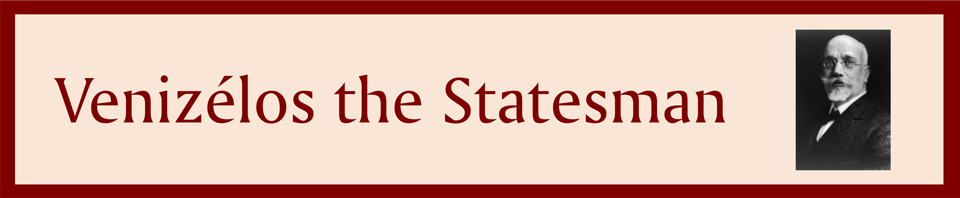
The pages listed in this menu sketch the life and career of Elefthérios Venizélos (except for his role in the achievement of Crete’s union with Greece, which is covered on the last page of Crete’s Long Story, here).
Hover the cursor on any page title for a brief description of the contents; click the title to go to the page.
Hover the cursor on any page title for a brief description of the contents; click the title to go to the page.
As prime minister, Venizélos formed alliances and built up the military to prepare his country for a war with the Ottoman empire. That was a success for Greece, and so was the war with Bulgaria that followed. Many ethnic Greeks now lived within their country’s enlarged borders, and Greece had earned new respect in Europe.
When World War I broke out, prime minister Venizélos wanted Greece to join the Allies. King Constantine didn’t, and he had a high-handed way of ignoring or dismissing any government whose actions displeased him, seriously violating the constitutional standard of acceptable behavior for a Greek monarch. Although Venizélos won in the end, the struggle polarized Greek politics and made it a much nastier business than before.
Venizélos was in a position to influence the peace treaty between the Allies and Turkey. Even before it was signed, he persuaded the Allies to let Greek troops occupy Smyrna (Turkish Izmir), a seaport city with a large non-Turkish population, many but not all Greek. The treaty, signed in 1920, gave this territory and a good deal more to Greece, but it was already out of date: Mustafa Kemal had created a Turkish national movement and trained an army to serve it. Foolishly, Venizélos ordered a Greek invasion of central Asia Minor to eliminate this threat. The end result, though not entirely Venizélos’ fault, was a military and economic disaster for Greece and caused great suffering for the Greeks who lived in Turkey.
Within a month of touching off the fuse of the “Asia Minor Catastrophe,” as it's called in Greece, Venizélos had suffered an unexpected electoral defeat, and was still out of power when the roof finally fell in almost two years later. The surviving military, and the country at large, were in a bloody mood, and their fury fell on King Constantine and his royalist government. A revolutionary committee of military officers seized power. Venizélos, sensibly leery of coups, declined their offer to put him in charge, but skillfully negotiated a peace with Turkey on quite reasonable terms. The Great Idea, as he recognized, was well and truly dead.
Greece declared the Second Hellenic Republic, which lasted 11 years, during which there were 23 changes of government, one dictatorship, and 13 coups. Popular support was split almost evenly between two ideologies, one liberal and often republican, the other conservative and usually royalist. This made it hard to get anything done. But there was one exceptional period of four and a half years, between 1928 and 1932, when Venizélos held power, and governed fairly and intelligently. He wasn’t skilled in economics, however, and couldn’t overcome the problems that came from absorbing a million and a half penniless refugees from Asia Minor. The Great Depression finally did his government in.
Venizélos served as leader of the opposition until 1934, but finally retired to Chaniá. The government moved slowly toward restoring the monarchy, and when some republican officers plotted to prevent this with a coup, they persuaded Venizélos, who should have known better, to lend his name to the conspiracy. It was crushed, and he had to flee the country. A plebiscite brought George II, Constantine’s son, back to the throne of Greece. The king chose to take his political advice from conservative politicians who feared that the country was mortally threatened by Bolshevism after the Communist Party began calling general strikes. One of these politicians, the former general Ioánnis Metaxás, became prime minister in April, 1936, and a few months later declared a state of emergency, informing the Greeks that he had decided to assume as much power as he needed to save them from the catastrophes that threatened. Venizélos, however, didn't live to see that sad day: he had died of a stroke in March. His body was brought home from Paris and buried on the hill of Akrotíri, outside Chaniá, where a band of rebels in 1897 had chosen him to lead them.