-
 ArrivalIráklio has two bus stations; this one serves the routes that connect major cities via the east-west highway that runs along the north coast. We had just gotten off when Dorothea took this picture of me (in my cool Dolce & Gabbana knockoff sunglasses) studying a local map. It had shown the Lató Boutique hotel to be a short distance from the station, and so it was, horizontally, but it was also at the top of a bluff and (not being mountaineers) we needed to find an indirect route to get up there.
 -
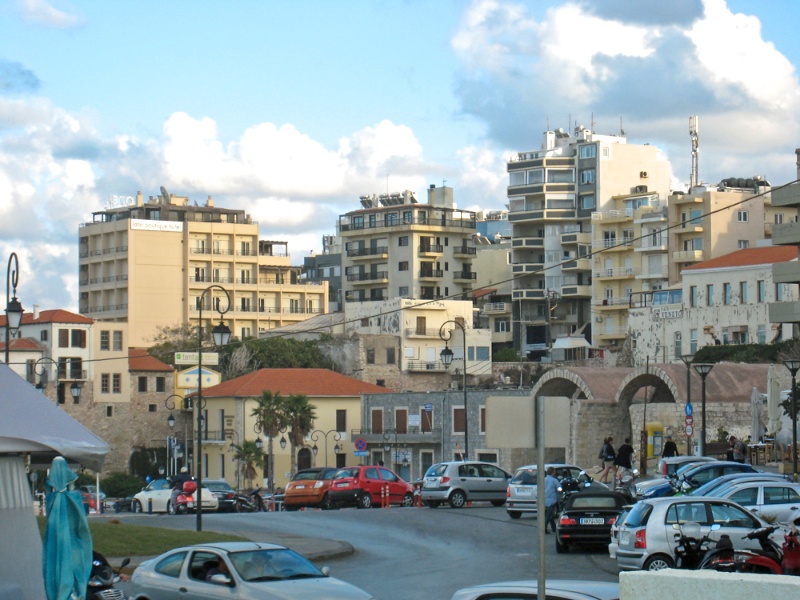 Above it allThis picture shows the Lató on its high perch, the large yellow building at the left. This picture wasn't taken from the bus station, but from a place near the waterfront farther up the street. We didn't have to walk this far to find the stairway that led up to the Lató, though we did hunt (in vain) for an easier way to get to it than hauling our luggage up those stairs. The rounded roofs at the right are all that's left of a couple of Venetian arsenali like the ones we saw in Chaniá.
 -
 Venetian doorwayIráklio lost more of its old town in the air raids of 1941 than the the other cities we visited. But it isn't all gone. We passed this doorway on the same street as our hotel.
 -
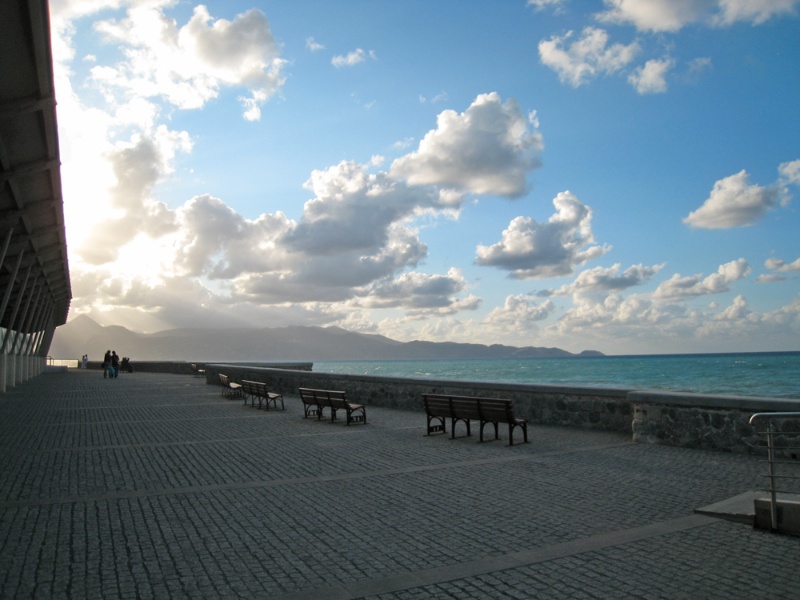 Seaside promenadeAs our first day in Iráklio was coming to an end, there were more people in the seaside tavernas than in the brisk wind outside. But the sea and sky were putting on a spectacle.
 -
 ShutterbugAs the light continued to change, we spent quite a while taking pictures.
 -
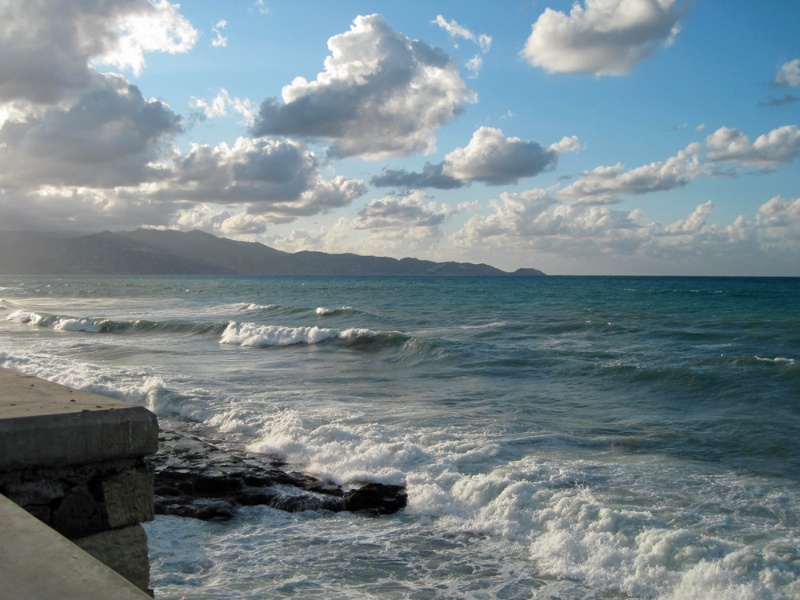 Sea and sky #1This was where Dorothea was pointing her camera in the last picture. The bus from Réthymno had brought us over these low mountains to the west of the city.
 -
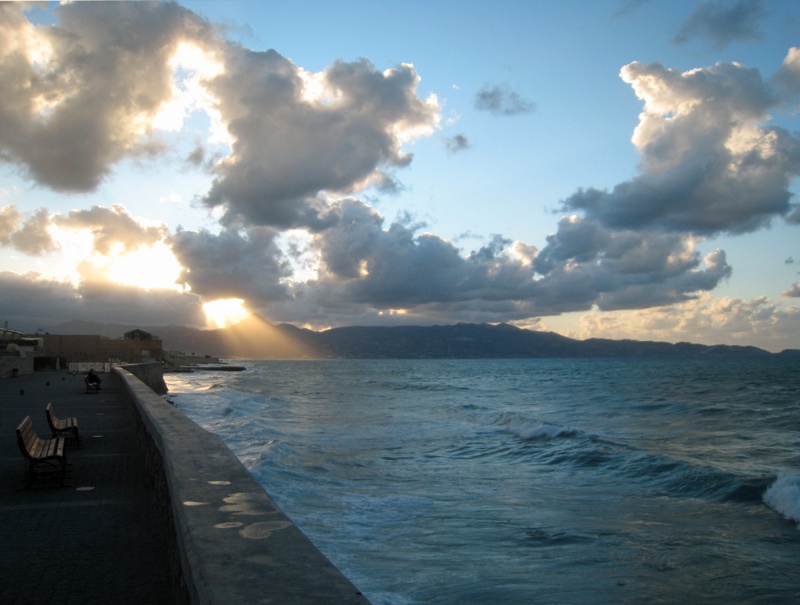 Sea and sky #2This was about the last we saw of the sun, but it continued to light up the clouds over the sea, as the next few pictures demonstrate.
 -
 A bit of old IráklioAs often happens in Greece, construction work turned up something worth excavating cautiously. This site is still being explored. I'm not sure how many layers it goes down, but a casual look over the wall suggests that some layers are there. The site isn't yet on official display, though anyone walking past can peek at it.
 -
 Sea and sky #3In this picture you can see the cloud bank that was reflecting most of the light in the pictures that follow. On the horizon is an island called Día, which looks like a giant lizard. According to legend, it was once a real giant lizard that threatened the island until Zeus threw a thunderbolt that turned it to stone. In this picture it is still getting sunlight, but in the ones that follow it's just a lizard-shaped silhouette.
 -
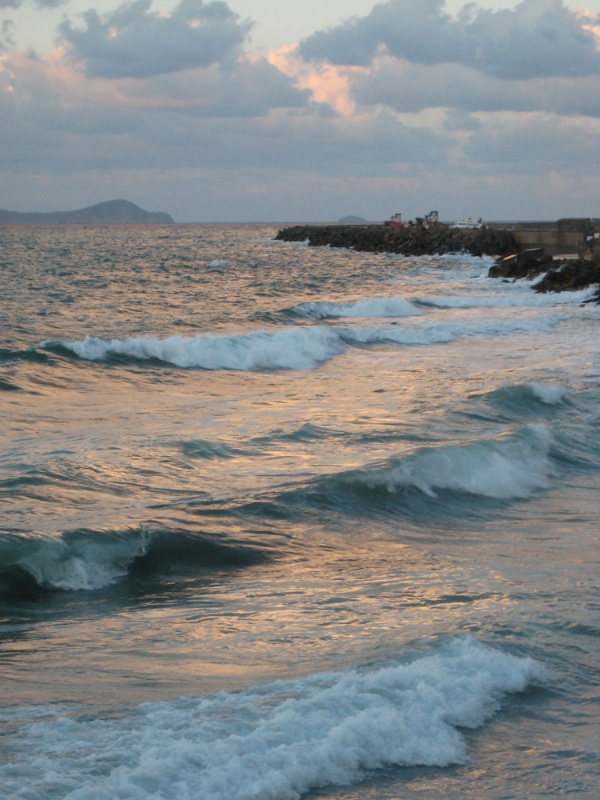 Sea and sky #4The sunlight hitting the clouds now took on more of a sunset shade. We were getting closer to the mole (the stone jetty you can see at the right), which shelters the small, round Venetian harbor, but also goes well beyond it to protect the much larger port area where ferries dock.
 -
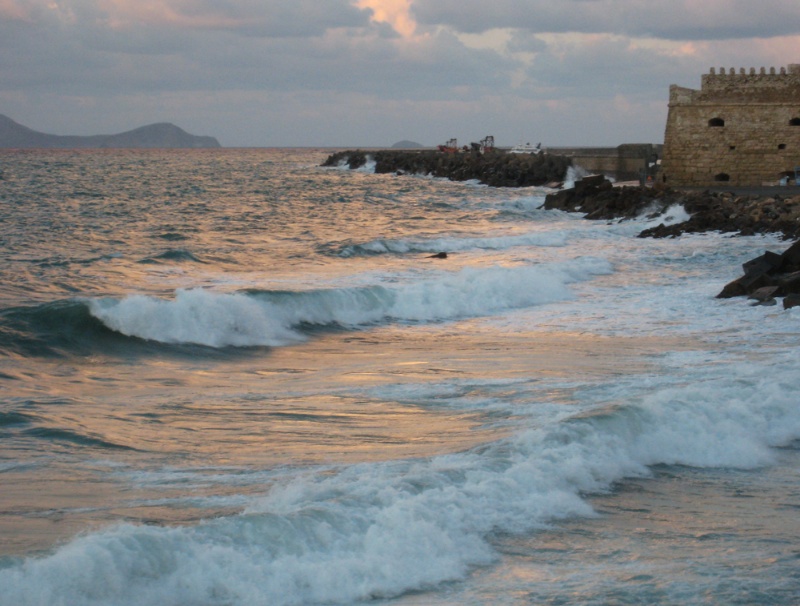 Sea and sky #5The Venetian fortress that protected the harbor starts to become visible at the right. Its builders called it Rocca del Mare ('sea rock') but when the Turks took it over it became known as the Koúle, which an Internet dictionary tells me can mean 'tower, gun turret, dungeon, gazebo, steeple.' I guess the second and third definitions fit, though the others certainly don't.
 -
 Sea and sky #6More of the Koúle and the lizard are visible here.
 -
 Sea and sky #7Here are the reflective cloud bank, the lizard island, and the fort, all at once.
 -
 Fishing boats in the Venetian harborThe little harbor was crowded with small boats of both working and pleasure types. Fishermen seemed to have dibs on the places next to the mole, perhaps because they have more serious unloading business than yachtsmen do.
 -
 Pleasure boatsPleasure craft filled the rest of the Venetian harbor. In the background to the left, you can see a big white ferry; it's moored outside the small harbor, in the large port area sheltered by the mole.
 -
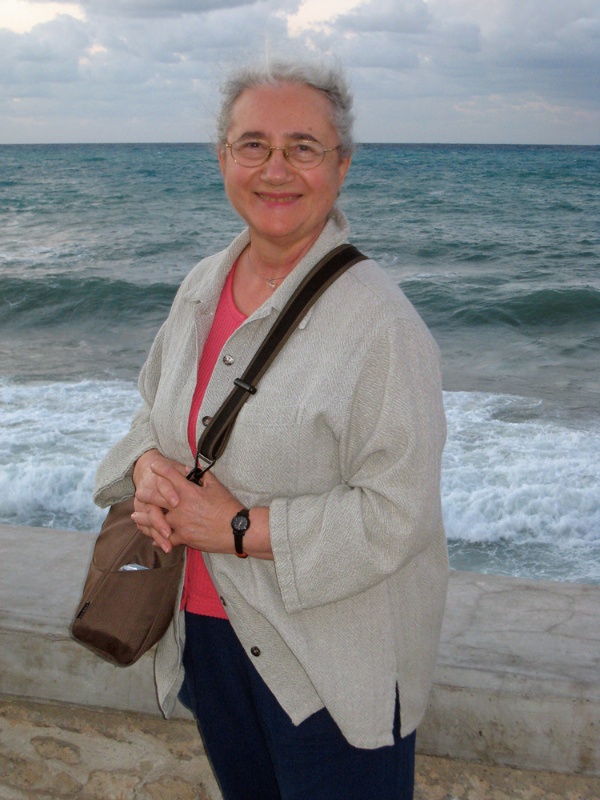 Dorothea braving the windIt's a wonder there was still enough light to take this picture. The breeze was stiff, and we were, as Dorothea recorded in her notes, "chilled and buffeted," so we were glad to go inside the Ippókampos ouzerí for dinner—our first indoor meal since arriving in Crete.
 -
 Church of St. TítosTaken during our Sunday stroll on 25 Avgoústou. The original Byzantine church was rebuilt as a Catholic church by the Venetians, then turned into a mosque by the Turks, who rebuilt it again in the 19th century. When the last Turks left, in the 1920s, it was once more rebuilt and reconsecrated as an Orthodox church, but, even though it commemorates Crete's patron saint, it isn't the Orthodox cathedral. The Greeks (who had been allowed a bishop by the Turks, though not by the Venetians) already had a cathedral. Saint Títos' skull is preserved in his church. The Venetians had taken it with them when they lost the island, but Venice returned the relic in 1966.
 -
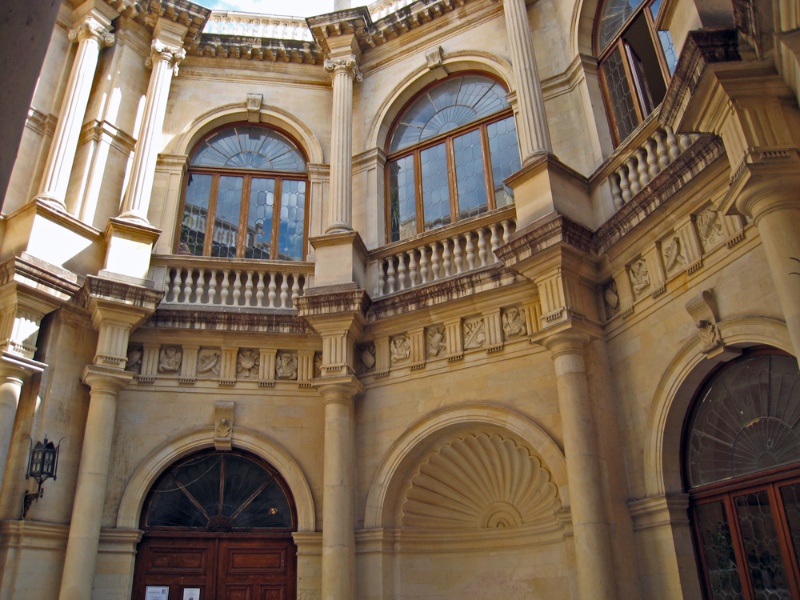 Venetian loggia #1Like the other leading cities during the Venetian period, Candia (which was then the name of Iráklio) had a loggia—which, being located in the capital, was in many ways the center of Crete's politics (informally, of course, because the Venetian doge and senate were the official rulers). It became the city hall after independence was achieved, but needed rebuilding in the 20th century. This was done with great care, and as the next couple of pictures show, the classical Venetian ambience hasn't been lost.
 -
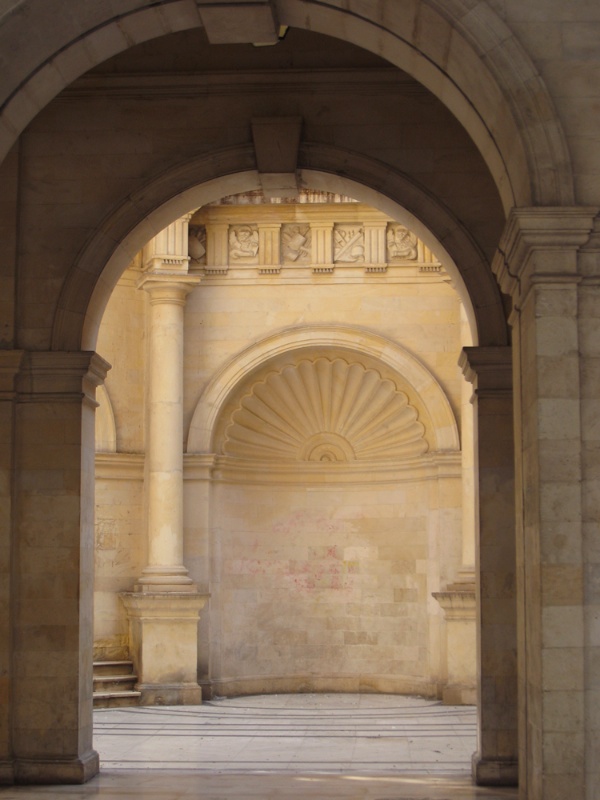 Venetian loggia #2This can't be very different from the way it looked in the 16th or 17th century.
 -
 Venetian loggia #3Yes, it's the same doorway again—but isn't it great?
 -
 Venetian loggia #4Architecturally, to qualify as a loggia, a building had to have at least one side open to the street. So this one qualifies. Through the arches you can see Venizélos Square, where several major streets intersect. It's also called "the Lions," "Lions Square," and "Fountain Square" because the Morosini Fountain (featuring lions) is in the middle.
 -
 Portico of San MarcoThis portico, facing Venizélos Square, belongs to the Basilica of San Marco, once the principal Venetian church in Candia (dedicated, of course, to Venice's patron saint). The structure behind was (I assume) part of the original church, but after three centuries of being a mosque, little of its original character remained. Today it's exhibition space, and the Venetian porch serves as a place to hang out, or to put on impromptu concerts—a small rock band was setting up when we came by. The man sitting on a box was one of several displaced Africans we saw here and there, trying to get by as a peddler of mechanical toys.
 -
 Morosini Fountain #1This elaborate fountain is named for a Provedditore Generale (i.e., 'superintendant') of Crete, Francesco Morosini, who had it built in 1626–1628, a few decades before Venice lost Crete to the Turks. (He was not the general Francesco Morosini who surrendered the city to its besiegers in 1669, who was only 9 years old in 1628, but was doubtless a kinsman. The Morosinis were an important aristocratic family who held various high offices in Venice and its empire over the centuries.)
The fountain crowned a major civil engineering triumph: the delivery of fresh water to the city from a location 15km away in the mountains. The 8-lobed shape of the basin cleverly maximizes the space where citizens several rungs down the ladder from aristocrats could fill their water jars without having to wait too long for the opportunity. -
 Morosini Fountain #2Wherever Venetians have been, one tends to find lions—the lion was the symbol of the evangelist St. Mark, whom the city revered as its patron. The Venetian engineers contrived, by bringing the water through pipes that narrowed as they came up, to have it gush forth from the lions' mouths into the basin below. As you can see, it's no longer gushing forth, but the pipe in the lion's mouth (and the rust stains below it) are evidence that it once did.
 -
 Morosini Fountain #3The sides of the basin are appropriately decorated with classical images of an aqueous nature.
 -
 Balcony view—morning #1Our room was on the west side of the building. Here, we're looking toward the big buildings on 25th Avgoústou.
 -
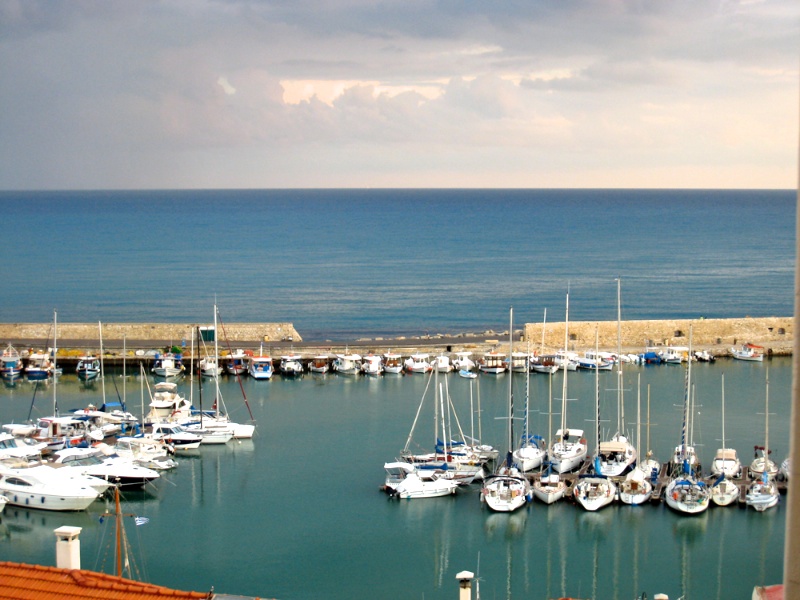 Balcony view—morning #2A turn to the right, and we could look down onto the Venetian harbor.
 -
 Balcony view—eveningTaken when the sun was almost, but not quite gone.
 -
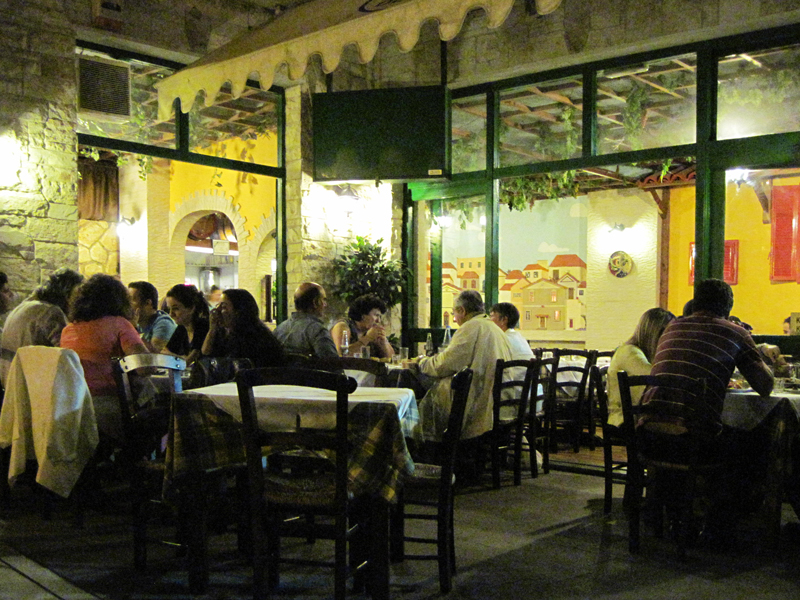 'Deucalion's Courtyard'I Avlí tou Defkalíona, where we ate dinner on Monday night. This was taken from our table, across a “street” (actually a footway only 5 or 6 feet wide) from the tables in the picture.
 -
 Iráklio's marketOn Tuesday, the market on 1866 Street was, understandably, a good deal livelier than we'd found it on Sunday.
 -
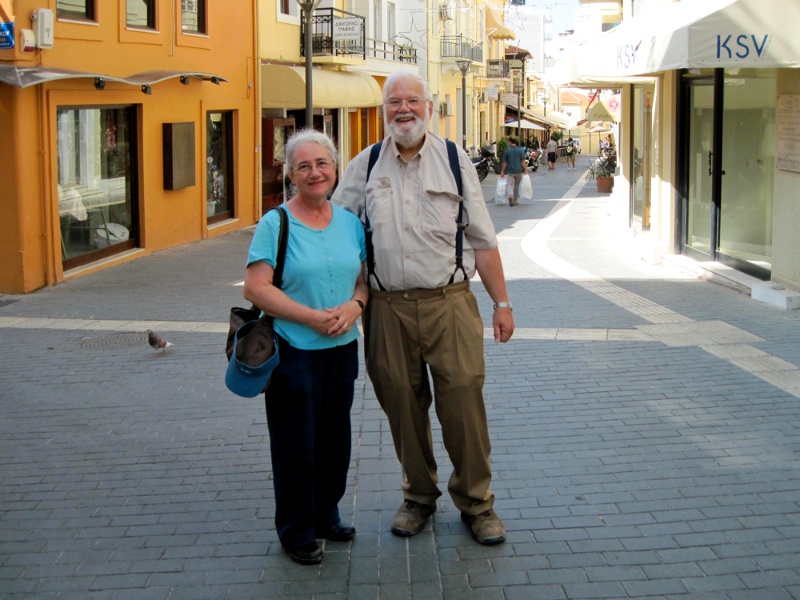 Vacation pictureOn this quiet pedestrian street near Venizélos Square, we saw a couple of fellow tourists photographing each other and offered to take one of them together. They returned the favor.
 -
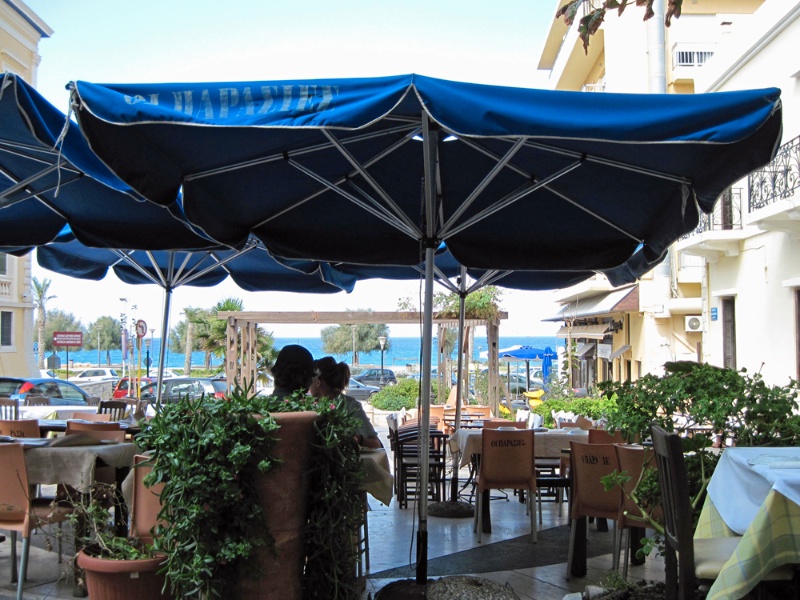 Lunchtime at… um...We're still uncertain whether this was one restaurant with two names, or two restaurants with one courtyard. But the food was good, and the view from our table was pleasant.
 -
 Restaurant courtyardSome signs said Parasiés and others (like the one you can see in this picture) said Paraskevás. If these are separate establishments, we don't know which one we ate in.
 -
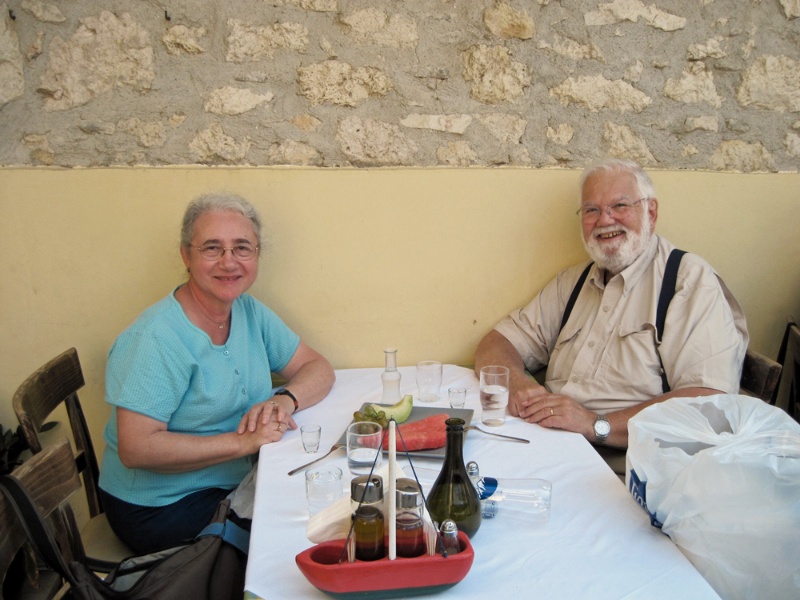 Postprandial blissThe waiter obligingly captured our contentment as we sat over the complimentary watermelon and rakí.
 -
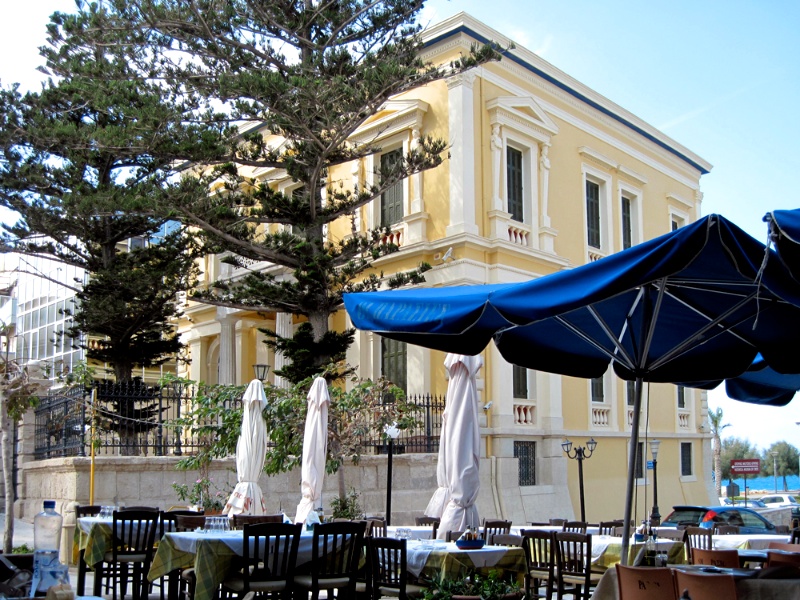 MuseumThis handsome old mansion (built in 1903) houses the Historical Museum, which we visited after eating lunch next door. Its main entrance faces the water side, and doesn't show in this picture.